
Sports betting odds are the foundation of every wager. They determine how much a bettor can win and represent the probability of a specific outcome in a sporting event. For beginners, odds can initially appear confusing because they are presented in different formats depending on the region.
Understanding how sports betting odds work helps bettors interpret betting markets, calculate potential payouts and make more informed decisions when placing wagers.
This beginner-friendly guide explains what betting odds are, how they are calculated and how to read the most common odds formats used in sports betting.
What Are Sports Betting Odds?
Sports betting odds represent the likelihood of a particular outcome in a sporting event and the potential payout for a successful bet.
For example, odds may represent:
- a football team winning a match
- a tennis player winning a set
- the total number of goals scored in a game
- whether a specific event occurs during a match
Bookmakers calculate odds using complex statistical models, historical data and betting market activity. These calculations are based on mathematical concepts closely related to Probability theory.
In simple terms:
- Lower odds indicate a higher probability of winning
- Higher odds indicate a lower probability but a larger potential payout
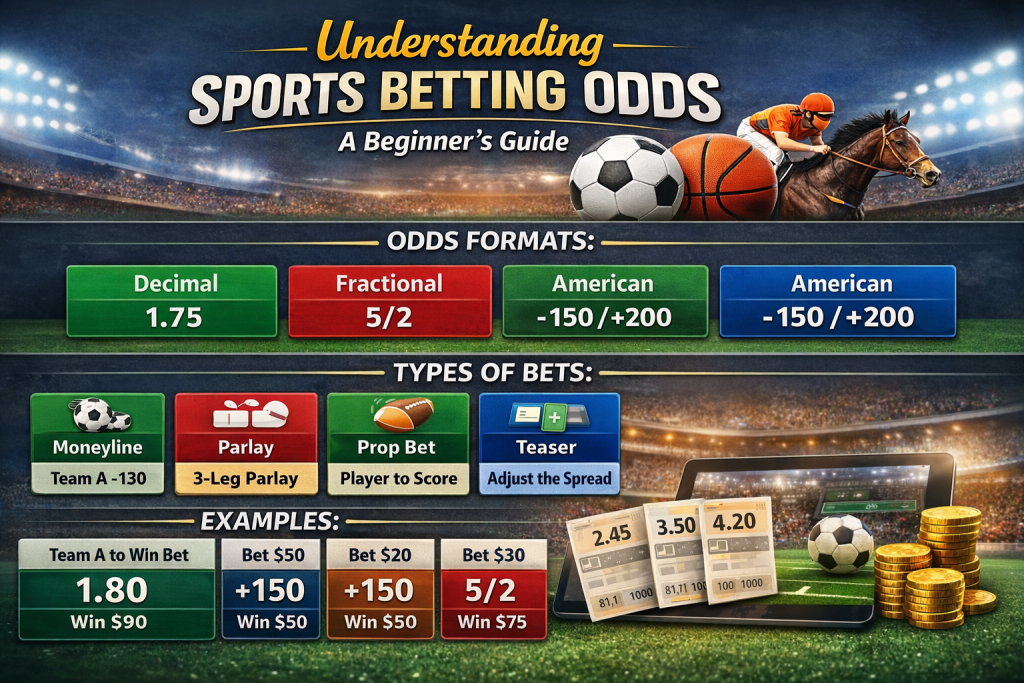
The Three Main Types of Sports Betting Odds
Sports betting odds appear in three main formats worldwide:
- Decimal odds
- Fractional odds
- American odds (moneyline)
Although these formats look different, they all represent the same probability and payouts.
Decimal Odds
Decimal odds are the most common format globally, especially in Europe, Australia and Canada. They are also the easiest format for beginners to understand.
Decimal odds show the total return for every unit wagered, including the original stake.
Example of Decimal Odds
| Bet Amount | Odds | Total Return | Profit |
|---|---|---|---|
| $10 | 1.50 | $15 | $5 |
| $10 | 2.00 | $20 | $10 |
| $10 | 3.50 | $35 | $25 |
How Decimal Odds Are Calculated
The formula is simple:
Total payout = Stake × Odds
Example:
Stake: $20
Odds: 2.50
Total return = $20 × 2.50 = $50
Profit = $30
Real Betting Example
Imagine a football match between Team A and Team B.
| Outcome | Decimal Odds |
|---|---|
| Team A wins | 1.80 |
| Draw | 3.50 |
| Team B wins | 4.20 |
You bet $20 on Team A to win at odds of 1.80
Calculation:
Total payout = Stake × Odds
20 × 1.80 = $36
Profit = $16
Decimal odds are considered beginner-friendly because the calculation is straightforward.
Probability calculations are also relevant in casino games such as Roulette, where each spin has predetermined odds based on the number of possible outcomes.
Understanding probability and payout calculations is also useful in many casino games. For example, players studying mathematical advantage often explore strategy-based table games like Blackjack, where decision-making is closely tied to probability and odds.
Fractional Odds
Fractional odds are traditionally used in the United Kingdom and Ireland and are especially common in horse racing.
These odds appear as fractions such as:
- 5/1
- 7/2
- 10/3
The fraction represents the profit relative to the stake.
Example of Fractional Odds
| Fractional Odds | Stake | Profit | Total Return |
|---|---|---|---|
| 2/1 | $10 | $20 | $30 |
| 5/1 | $10 | $50 | $60 |
| 10/1 | $10 | $100 | $110 |
Real Betting Example
Football match:
| Outcome | Fractional Odds |
|---|---|
| Team A | 3/2 |
| Draw | 2/1 |
| Team B | 5/1 |
You bet $20 on Team A at 3/2 odds
Calculation:
Profit = 20 × (3 ÷ 2) = $30
Total return = $50
While this format is common in traditional betting markets, beginners often find decimal odds easier to interpret.
American Odds (Moneyline)
American odds are primarily used in the United States and are displayed as positive or negative numbers.
Positive odds show how much profit a $100 bet would generate, while negative odds show how much must be wagered to win $100.
Example of American Odds
| American Odds | Stake | Profit | Total Return |
|---|---|---|---|
| +150 | $100 | $150 | $250 |
| +200 | $100 | $200 | $300 |
| -150 | $150 | $100 | $250 |
Example:
Odds: +200
Stake: $100
Profit = $200
Total return = $300
Example with negative odds:
Odds: -150
You must bet $150 to win $100.
The plus (+) and minus (-) symbols indicate whether a team is an underdog or favorite.
| Odds | Meaning |
|---|---|
| +200 | Underdog |
| +150 | Slight underdog |
| -150 | Favorite |
| -200 | Strong favorite |
- Positive odds (+) show how much profit you would win from a $100 bet
- Negative odds (-) show how much you must wager to win $100
Negative odds indicate the favorite team, meaning the bookmaker believes that outcome is more likely.
Example:
Odds: -150
This means you must bet $150 to win $100 profit.
Real Betting Example
Basketball game:
| Team | Odds |
|---|---|
| Team A | -150 |
| Team B | +130 |
Betting $150 on Team A (-150):
Profit = $100
Total return = $250
Betting $100 on Team B (+130):
Profit = $130
Total return = $230
Comparing Different Odds Formats
The table below shows how the same probability appears across different odds formats.
| Decimal | Fractional | American | Implied Probability |
|---|---|---|---|
| 1.50 | 1/2 | -200 | 66.7% |
| 2.00 | 1/1 | +100 | 50% |
| 2.50 | 3/2 | +150 | 40% |
| 3.00 | 2/1 | +200 | 33.3% |
This comparison helps bettors understand how different regions represent the same betting markets.
What Is Implied Probability?
Implied probability is the probability of an event occurring based on the odds offered by bookmakers.
For decimal odds, the formula is:
Implied probability = 1 ÷ decimal odds
Implied Probability Examples
| Decimal Odds | Implied Probability |
|---|---|
| 1.50 | 66.7% |
| 2.00 | 50% |
| 3.00 | 33.3% |
| 5.00 | 20% |
Understanding probability is useful not only for sports betting but also for casino games based on mathematical outcomes. For example, in Roulette each spin has a fixed probability determined by the number of slots on the wheel.
Why Sports Betting Odds Change
Sports betting odds are dynamic and may change before an event begins. Several factors can influence these changes.
Team News
Player injuries, suspensions or lineup changes can significantly affect expectations for a match.
Betting Market Activity
If a large number of bettors place wagers on one outcome, bookmakers may adjust the odds to balance their risk.
Weather Conditions
In outdoor sports such as football or tennis, weather conditions can affect gameplay and influence odds.
Statistical Updates
Advanced statistical models constantly update probabilities as new data becomes available.
Understanding these changes is important for interpreting betting markets.
Payment Technology in Modern Betting
Sports betting platforms today often support digital and blockchain-based payments, which make deposits and withdrawals faster and more secure. Players interested in learning more about these innovations can check out our content on Crypto Casinos, which explores how modern payment methods integrate with online gaming.
These technological developments have significantly changed how players interact with online betting platforms.
Tips for Using Odds to Make Informed Betting Decisions
Here are practical tips to help you use odds more effectively:
Know the Formats
Be comfortable reading all odds formats, it helps when comparing markets or different sportsbooks.
Understand Implied Probability
Converting odds into implied probability gives insight into how likely a bookmaker thinks an event is to happen versus your own assessment.
Compare Lines Across Platforms
Different sportsbooks may offer slightly different odds for the same event, and a small difference can affect profit over time.
Use Odds Movement
Tracking how odds shift before a game can reveal market sentiment and potential value opportunities.
Stick with Sports You Know
Beginners are often advised to start with sports they understand well, it’s easier to assess probabilities and make educated decisions.
Bet Within Your Limits
Set a budget and don’t chase losses – responsible wagering helps ensure betting remains entertainment rather than risk.
Why Understanding Sports Betting Odds Is Important
Learning how sports betting odds work helps bettors:
- calculate potential winnings
- understand the probability of outcomes
- compare betting markets
- evaluate whether odds offer potential value
Without understanding odds, it becomes difficult to interpret betting markets or evaluate the risk and reward of a wager.
Sports Betting Odds FAQ
-
What do betting odds actually represent?
Odds represent both the likelihood of an outcome and how much you stand to win if your bet succeeds.
-
Which odds format is easiest for beginners?
Decimal odds are generally considered the easiest because they clearly show total payout including your original stake.
-
Can odds tell me which outcome will happen for sure?
No. Odds estimate probability – they are not guarantees. Even “favorites” can lose.
-
Why do odds differ across sportsbooks?
Different sportsbooks may interpret data differently and balance risk through market activity, leading to slight variations.
-
Do odds reflect true probability?
Not always. Bookmakers include a margin (vig) to ensure profitability, so implied probability might differ from true probability.
