
Football is more than just a sport across the Middle East and North Africa. Fans from Jordan, UAE, Saudi Arabia, Iraq, Oman, and other Arabic-speaking countries follow every Premier League match, track player statistics, and debate team selections weekly. Fantasy football adds another layer of excitement by allowing fans to build virtual squads and compete based on real-life player performances. It remains the most popular fantasy sport worldwide.
Whether you are completely new to the concept or looking to improve your results, this guide explains what is fantasy football, how leagues work, the different contest formats available, and where to find the best fantasy football sites. We will also cover fantasy football tips, tournament strategies, and the growing popularity of fantasy football real money competitions.
What Is Fantasy Football
For newcomers asking what is fantasy football, it is an online game where participants create virtual teams made up of real football players. Points are awarded according to how those players perform in actual matches.
For example, if your selected striker scores a goal in a Premier League match, your fantasy team earns points. Defenders earn points for clean sheets, midfielders gain points from goals and assists, while goalkeepers benefit from saves and shutouts.
The objective is simple: build a squad that accumulates more points than competing teams over a matchday, tournament, or full season.
Fantasy football combines football knowledge, statistical analysis, strategy, and competition. Unlike traditional sports betting, success depends heavily on team management, player selection, transfers, captain choices, and long-term planning.
What Is a Fantasy Football League
Many newcomers ask what is a fantasy football league, especially when they first discover fantasy sports platforms. Simply put, a fantasy football league is a competition where multiple participants, often called managers, build and manage virtual football teams while competing against one another based on the real-life performances of selected players.
Fantasy leagues can range from small private groups of friends to massive global competitions involving hundreds of thousands of participants. Every manager drafts or selects players according to the platform’s rules and earns points whenever those players perform well in actual football matches.
The appeal of fantasy football leagues lies in the fact that they transform football fans from spectators into active participants. Rather than supporting only one club, managers often follow multiple matches each week because their fantasy team’s success depends on players from various clubs and leagues.
Most fantasy football leagues operate over an entire season, although some may focus on specific tournaments such as the UEFA Champions League, FIFA World Cup, or European Championship. Throughout the competition, managers make transfers, adjust formations, select captains, and respond to injuries or suspensions.
Private leagues are particularly popular because they add a social and competitive element. Friends, colleagues, and family members can challenge each other throughout the season, creating rivalries that often become as exciting as the real football action itself.
Common Types of Fantasy Football Leagues
| League Type | Description |
|---|---|
| Public Leagues | Open competitions anyone can join |
| Private Leagues | Invitation-only leagues among friends or communities |
| Head-to-Head Leagues | Teams compete directly against another manager each round |
| Overall Points Leagues | Rankings are based on total points accumulated |
| Tournament Leagues | Short-term contests linked to specific events |
| Real Money Leagues | Competitions featuring entry fees and prize pools |
Regardless of format, the objective remains the same: build the strongest possible squad and outscore competing managers through smart decision-making and football knowledge.
How Fantasy Football Works
Understanding what is fantasy football becomes much easier once you learn how the game actually works. While scoring systems vary slightly between platforms, the overall concept is remarkably simple.
At the beginning of a competition, managers receive a virtual budget that they use to assemble a squad of real football players. Every player has a price based on their reputation, form, and expected performance level. Because the budget is limited, managers must balance expensive star players with affordable value options.
Once the team is selected, points are awarded based on real-life match performances. Goals, assists, clean sheets, saves, and other positive actions generate fantasy points, while yellow cards, red cards, and missed penalties can reduce scores.
Each week, managers must decide which players will start and which will remain on the bench. One player is usually designated as captain, earning bonus or double points depending on the platform’s rules. Choosing the right captain is often one of the most important decisions in fantasy football.
The game continues throughout the season, with managers regularly making transfers to improve their squads. Injuries, suspensions, fixture difficulty, player form, and tactical changes all influence transfer decisions.
Successful fantasy football managers do far more than simply pick famous players. They study statistics, analyze upcoming fixtures, monitor team news, and identify emerging talent before competitors notice them.
Typical Fantasy Football Process
- Register on a fantasy football platform.
- Receive a virtual transfer budget.
- Select a squad of real football players.
- Choose your starting lineup and captain.
- Earn points based on real match performances.
- Make transfers and adjustments throughout the season.
- Compete against other managers for rankings and prizes.
This combination of football knowledge, strategic planning, and ongoing team management is what makes fantasy football so engaging for millions of fans worldwide.
Premier League Fantasy Football Explained
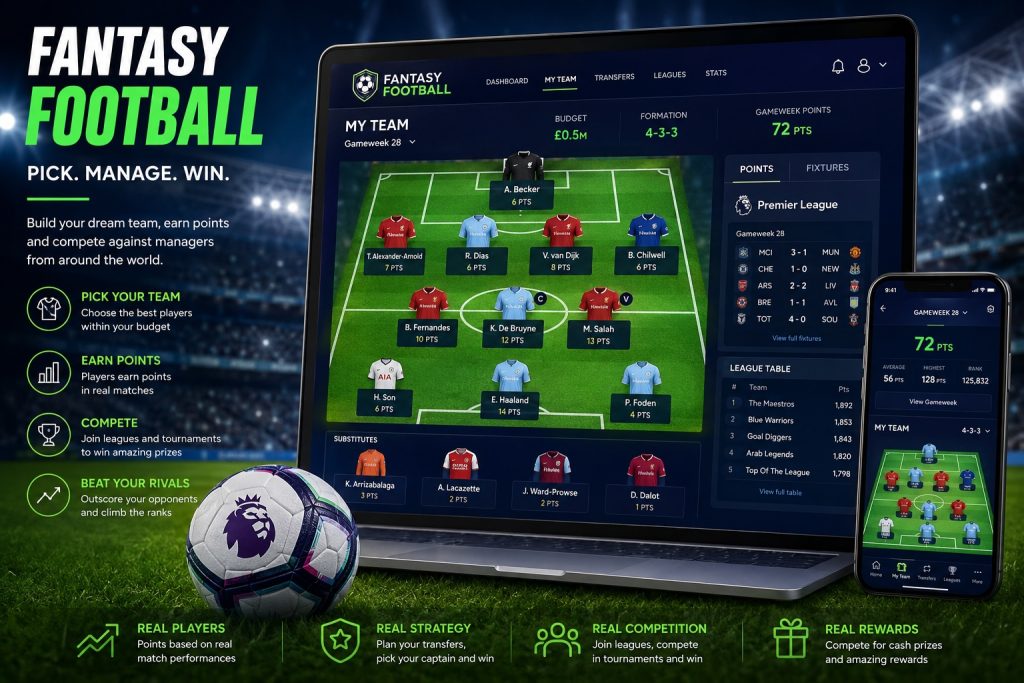
When discussing fantasy sports, no format is more popular than premier league fantasy football. The Premier League’s global popularity has helped make Fantasy Premier League (FPL) the world’s most widely played fantasy football game, attracting millions of managers every season.
Premier League fantasy football allows users to build squads consisting of players from all Premier League clubs. Managers must stay within a fixed budget while selecting goalkeepers, defenders, midfielders, and forwards. Every gameweek, points are awarded based on how these players perform in actual Premier League matches.
One of the biggest reasons for the success of Premier League fantasy football is the depth of available information. Fans have access to extensive player statistics, injury reports, fixture analysis, expected goals data, and expert predictions. This wealth of information rewards managers who invest time in research and strategic planning.
The Premier League’s highly competitive nature also contributes to the excitement. Unlike some leagues where a handful of clubs dominate, Premier League teams often produce unpredictable results, creating opportunities for fantasy managers to gain an edge through smart selections.
For football fans across Qatar, Bahrain, Morocco, Egypt and the wider Arab world, Premier League fantasy football offers an additional way to engage with one of the most-followed competitions on the planet. Every goal, assist, save, and clean sheet can influence fantasy rankings, making even seemingly minor matches far more exciting to watch.
A typical Premier League fantasy season runs from August to May and includes dozens of gameweeks. Managers continually adjust their squads, use special chips or bonuses, and compete in both global rankings and private leagues.
Why Premier League Fantasy Football Is So Popular
Several factors have helped Premier League fantasy football become a worldwide phenomenon:
- Millions of active players participate every season.
- The game is free to join.
- Extensive player statistics are readily available.
- Weekly matches create constant engagement.
- Private leagues encourage friendly competition.
- Strategic decisions have a major impact on results.
- Mobile apps make team management easy.
For many football supporters, watching Premier League matches and managing a fantasy team have become equally important parts of the football experience. The combination of competition, strategy, and football knowledge keeps managers engaged throughout the entire season and explains why Premier League fantasy football remains the industry’s benchmark fantasy sports product.
Fantasy Football Real Money Competitions
The popularity of fantasy football real money contests has grown significantly over the past decade, attracting football fans who want to combine their sporting knowledge with the opportunity to compete for cash prizes. Unlike traditional season-long fantasy leagues that are often played for bragging rights, real money fantasy football contests involve entry fees and prize pools distributed among the highest-performing participants.
In these competitions, players pay a small buy-in to enter a contest. Depending on the platform and tournament format, prize pools can range from modest amounts to substantial payouts. Winners are determined entirely by the fantasy points earned by their selected players during the contest period.
One reason real money fantasy football has become so popular is that success relies heavily on skill, research, and strategic decision-making. Participants must evaluate player form, fixture difficulty, injuries, expected playing time, and statistical performance before building their lineups. While luck can influence short-term results, long-term success often comes from disciplined analysis and consistent decision-making.
Real money contests are available in various formats. Some focus on a single matchday, while others may run throughout an entire tournament or football season. Daily fantasy contests are particularly popular because they provide immediate results and allow players to create completely new teams for each competition.
For experienced football fans, real money fantasy football adds another layer of excitement to watching matches. Every goal, assist, clean sheet, or save can have a direct impact on rankings and potential winnings, making even neutral matches more engaging.
Common Real Money Fantasy Football Formats
| Contest Type | Description |
|---|---|
| Head-to-Head | Two managers compete directly against each other |
| Double-Up Contests | Top-performing participants double their entry fee |
| Guaranteed Prize Pools (GPPs) | Large tournaments with fixed prize pools |
| Multi-Entry Tournaments | Players can submit multiple lineups |
| Season-Long Paid Leagues | Entry fees are collected before the season starts |
| Daily Fantasy Contests | Teams are created for a single matchday or slate |
Before participating in fantasy football real money contests, players should always review local regulations and platform terms to ensure compliance with applicable laws in their jurisdiction.
If you decide to participate in paid fantasy football contests, most platforms provide a variety of convenient banking options. Players can often fund their accounts using traditional debit or credit cards, while many international fantasy football sites also support e-wallets such as Skrill and Neteller, prepaid solutions like Paysafecard, and increasingly popular crypto payment methods. The availability of payment options varies between operators and jurisdictions.
Fantasy Football Tournaments
While season-long leagues remain extremely popular, fantasy football tournaments have become one of the fastest-growing segments of the fantasy sports industry. These competitions provide a shorter and often more intense experience, allowing managers to compete over a single matchday, weekend, tournament, or specific competition.
Fantasy football tournaments typically require managers to build teams for a defined event rather than an entire season. This format appeals to players who prefer quick results and the opportunity to participate in multiple contests throughout the year.
Major football competitions naturally create ideal fantasy tournament opportunities. Events such as the FIFA World Cup, UEFA European Championship, UEFA Champions League, and major domestic league matchdays often attract large numbers of fantasy participants seeking prizes and leaderboard positions.
Unlike season-long formats where consistency is essential, tournament success often requires a more aggressive strategy. Managers frequently look for differential players, under-owned stars, and high-upside selections that can separate them from thousands of competing entries.
One of the biggest advantages of fantasy football tournaments is flexibility. Players can enter contests whenever they choose without committing to an entire season. This makes tournaments attractive for both casual football fans and experienced fantasy managers.
Popular Fantasy Football Tournament Types
| Tournament Format | Duration |
|---|---|
| Single Matchday Contests | One day |
| Weekend Tournaments | Several days |
| Champions League Fantasy | Entire UCL match rounds |
| International Tournament Fantasy | World Cup or Euro competitions |
| Daily Fantasy Football | Individual fixture slates |
| Knockout Stage Contests | Limited to elimination rounds |
Fantasy football tournaments also create opportunities for larger prize pools because they often attract a higher number of participants. Some major tournaments feature thousands of entries competing for significant rewards, making lineup construction and player selection even more important.
For Arabic football fans following competitions across Europe, the Middle East, and international tournaments, fantasy football tournaments provide an exciting way to engage with matches while testing football knowledge against competitors from around the world. The combination of strategy, analysis, and competition explains why fantasy football tournaments continue to attract new players every season.
Fantasy Football Best Teams Strategy
There is no single formula for creating fantasy football best teams, but successful managers follow several principles.
- Balance Premium and Budget Players – a common mistake is spending too much on star players. The strongest fantasy teams usually combine elite performers with value selections that consistently earn points.
- Prioritize Consistent Performers – reliable players often outperform unpredictable stars over a long season.
- Analyze Fixtures – fixture difficulty plays a major role in fantasy success. Managers often target players facing weaker opponents over upcoming weeks.
- Monitor Injuries – a talented player cannot score fantasy points from the treatment room. Injury news should always influence transfers and team selection.
- Use Statistics – advanced metrics such as expected goals (xG), expected assists (xA), shots on target, and key passes provide deeper insights than traditional statistics alone.
Fantasy Football Tips
For Beginners:
Strong decision-making is often the difference between average and elite managers. These fantasy football tips can help improve results.
- Avoid Emotional Selections – many managers choose players from their favorite clubs regardless of form. Successful fantasy players focus on statistics and fixtures instead of loyalty.
- Plan Multiple Weeks Ahead – rather than making weekly decisions in isolation, look several gameweeks into the future.
- Captain Selection Matters – captains typically earn double points. Choosing the right captain can dramatically impact rankings.
- Don’t Chase Last Week’s Points – a player who scored twice last weekend may not repeat that performance. Focus on underlying trends rather than isolated results.
- Stay Updated – football changes quickly. Injuries, suspensions, rotation, and tactical changes can significantly affect fantasy outcomes.
For Advanced:
Experienced managers often employ more sophisticated strategies.
- Differential Players – differentials are low-ownership players capable of delivering significant points. When successful, they can help managers climb rankings quickly.
- Fixture Rotation – some managers rotate players based on favorable fixtures to maximize point potential.
- Statistical Modelling – advanced users increasingly rely on predictive models and data analysis to identify value opportunities before competitors.
- Risk Management – balancing safe picks with high-upside options is essential in both leagues and tournaments.
Best Fantasy Football Sites
The growing popularity of fantasy sports has led to the emergence of numerous fantasy platforms, each offering different game formats, scoring systems, contests, and prize structures. Choosing among the best fantasy football sites depends on your experience level, preferred contest type, and whether you enjoy free or paid competitions.
A high-quality fantasy football platform should provide an intuitive interface, accurate scoring, reliable customer support, mobile compatibility, and a wide range of contests. New players often prefer sites with beginner-friendly tools and educational resources, while experienced managers typically look for advanced statistics, large tournaments, and competitive prize pools.
The best fantasy football sites also invest heavily in security and fair play measures. Transparent rules, secure payment processing, and responsible gaming policies help create a trustworthy environment for users.
Another important consideration is contest variety. Some platforms focus primarily on season-long fantasy leagues, while others specialize in daily fantasy sports, real money competitions, or large tournament formats. Having access to multiple contest types allows players to enjoy different fantasy experiences throughout the football calendar.
What to Look for in Fantasy Football Sites
| Feature | Why It Matters |
|---|---|
| User-Friendly Interface | Easier lineup creation and team management |
| Mobile Compatibility | Manage teams anywhere and anytime |
| Live Scoring | Real-time contest tracking |
| Contest Variety | More ways to compete |
| Secure Payments | Protection of funds and transactions |
| Advanced Statistics | Better research and decision-making |
| Customer Support | Faster issue resolution |
| Reputation and Reliability | Long-term platform stability |
The strongest fantasy football sites successfully balance accessibility for beginners with advanced tools that appeal to experienced managers.
Best Daily Fantasy Football Sites
Daily fantasy sports have become one of the fastest-growing segments of the fantasy industry. Unlike traditional season-long formats, the best daily fantasy football sites allow users to create new teams for individual matchdays, weekend slates, or specific tournaments.
Daily fantasy football appeals to players who want immediate results rather than waiting months for a season-long league to conclude. Managers can build a fresh lineup for every contest, making each competition a new opportunity to test their football knowledge and strategy.
One of the biggest advantages of daily fantasy football is flexibility. Players can participate as often or as rarely as they choose. There is no need to manage transfers for months or worry about long-term squad planning. Instead, the focus shifts to short-term analysis, player matchups, recent form, and fixture selection.
The best daily fantasy football sites typically offer contests for major competitions such as:
- Premier League
- UEFA Champions League
- FIFA World Cup
- European Championship
- Domestic cup competitions
- International fixtures
Daily fantasy also encourages strategic creativity. Since lineups are rebuilt for every contest, managers can experiment with different approaches, player combinations, and tournament strategies.
Benefits of Daily Fantasy Football
| Advantage | Description |
|---|---|
| Fast Results | Contests are often settled within a day |
| Flexible Participation | Play only when desired |
| Fresh Lineups | New team every contest |
| Frequent Prize Opportunities | Multiple contests available daily |
| Less Long-Term Commitment | No season-long management required |
| Increased Variety | Different strategies for every slate |
For many football fans, daily fantasy provides a perfect balance between entertainment, competition, and strategic decision-making.
Best Paid Fantasy Football Sites
The best paid fantasy football sites cater to players seeking a more competitive environment with real-money prize opportunities. These platforms typically feature paid contests ranging from small-entry tournaments to major guaranteed prize pool events with substantial rewards.
Paid fantasy football has become increasingly sophisticated in recent years. Modern platforms provide extensive statistical tools, lineup optimization features, advanced projections, and detailed player analytics designed to help users make informed decisions.
When evaluating paid fantasy sites, reliability is arguably the most important factor. Players should prioritize platforms with transparent rules, established reputations, secure banking methods, and clearly defined prize structures.
Many experienced fantasy managers prefer paid contests because they often attract more serious competitors. This creates a challenging environment where research, football knowledge, and strategic planning become even more valuable.
Key Features of the Best Paid Fantasy Football Sites
| Feature | Importance |
|---|---|
| Secure Deposits and Withdrawals | Essential |
| Transparent Prize Structures | Essential |
| Fair Contest Rules | Essential |
| Mobile App Availability | High |
| Advanced Statistics | High |
| Large Tournament Selection | High |
| Multiple Payment Methods | Medium |
| Customer Support | Medium |
Players should always read platform terms and verify that paid fantasy contests are permitted within their local jurisdiction before participating.
Zweeler Fantasy Football
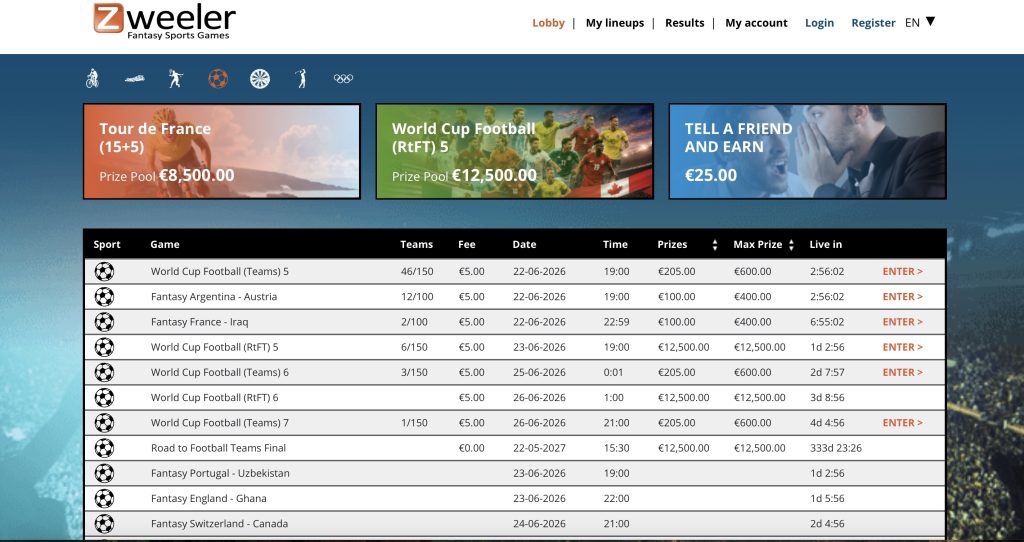
Among the growing number of fantasy platforms available today, Zweeler has built a strong reputation among experienced fantasy sports enthusiasts. The platform focuses on skill-based fantasy competitions and offers a wide range of football contests covering domestic leagues, European competitions, and major international tournaments.
Unlike many traditional fantasy platforms that emphasize casual gameplay, Zweeler is particularly popular among users looking for larger prize pools and more strategic competition. Its contests often attract experienced fantasy managers who rely heavily on statistics, projections, and detailed research.
One of Zweeler’s strengths is its tournament variety. Players can participate in competitions based on the Premier League, UEFA Champions League, European Championships, World Cup events, and numerous other football competitions throughout the year. This creates opportunities for both long-term and short-term fantasy play.
The platform also provides extensive player data and scoring information, allowing managers to make informed lineup decisions. Advanced fantasy players often appreciate the depth of statistics available when researching potential selections.
| Pros | Cons |
|---|---|
| Large football tournament selection | Can feel complex for beginners |
| Competitive prize pools | More suited to experienced players |
| Detailed statistics and research tools | Smaller player base than some global giants |
| Multiple international football competitions | Rules vary between tournaments |
| Strong focus on skill-based contests | Learning curve for new users |
For football fans who enjoy strategic fantasy sports and competitive tournaments, Zweeler can be an excellent option. The platform is particularly appealing to experienced managers who want something beyond basic season-long fantasy leagues. Its combination of football-focused contests, detailed statistics, and prize-driven tournaments makes it one of the more interesting fantasy football sites currently available.
For beginners, it may take some time to understand the scoring systems and contest formats, but players willing to learn can find a highly engaging fantasy football experience with opportunities to compete against knowledgeable football enthusiasts from around the world.
Is Fantasy Football Skill or Luck
One of the longest-running debates among fantasy sports players is whether success in fantasy football comes down to skill or luck. The reality is that both factors play a role, but their influence is very different depending on the timeframe being considered.
In any single match or gameweek, luck can have a significant impact. A player may miss an open goal, suffer an injury in the opening minutes, receive an unexpected red card, or be rested by their manager without warning. These unpredictable events can dramatically affect fantasy scores despite a manager making all the right decisions beforehand.
However, over the course of an entire season, skill becomes far more important than luck. Managers who consistently research player statistics, analyze fixtures, monitor injuries, and make strategic transfers tend to outperform those who rely solely on instinct or emotional selections. This is why the same names often appear near the top of fantasy football rankings year after year.
Fantasy football rewards preparation and decision-making. Successful managers study player form, expected goals (xG), expected assists (xA), clean sheet probabilities, and fixture difficulty ratings. They also plan transfers weeks in advance and avoid making impulsive decisions based on a single good or bad performance.
A useful comparison is poker. Luck can determine the outcome of a single hand, but over hundreds or thousands of hands, the most skilled players generally achieve the best results. Fantasy football works in a similar way. Individual gameweeks may be influenced by randomness, but season-long success usually reflects a manager’s knowledge and strategy.
Where Luck Influences Fantasy Football
Several factors remain outside a manager’s control:
- Unexpected injuries during matches
- Last-minute team rotation
- VAR decisions
- Own goals
- Penalty misses
- Refereeing decisions
- Extreme weather conditions
- Unpredictable football results
Even the most experienced fantasy managers cannot predict every outcome. Sometimes a carefully researched captain choice scores two points while an overlooked player delivers a hat-trick.
Where Skill Makes the Difference
Over the long term, successful managers gain an edge through:
| Skill Factor | Impact on Results |
|---|---|
| Fixture Analysis | Identifies favorable matchups |
| Statistical Research | Improves player selection |
| Squad Planning | Maximizes future opportunities |
| Budget Management | Creates stronger overall teams |
| Captain Selection | Increases scoring potential |
| Transfer Strategy | Maintains squad quality |
| Risk Assessment | Balances safe and differential picks |
These skills help managers make consistently strong decisions throughout a season, reducing the impact of short-term bad luck.
Why Experienced Managers Usually Finish Higher
If fantasy football were purely luck-based, rankings would be completely different every season. Instead, many top-performing managers repeatedly achieve strong finishes because they follow proven processes and make data-driven decisions.
They understand that fantasy football is not about predicting every goal or assist correctly. It is about giving yourself the highest probability of success over dozens of gameweeks. By consistently making better decisions than competitors, skilled managers gradually accumulate an advantage.
Conclusion
Fantasy football has evolved into one of the most popular ways for football fans to engage with the sport beyond simply watching matches. Whether you prefer free season-long leagues, competitive fantasy football tournaments, or fantasy football real money contests, the game offers a unique combination of football knowledge, strategy, analysis, and competition.
By understanding what is fantasy football, learning what is a fantasy football league, studying player statistics, and applying proven fantasy football tips, players can significantly improve their chances of success. From Premier League fantasy football and daily fantasy contests to large-scale tournaments with prize pools, there are formats suitable for every type of football fan.
However, fantasy football is not the only way to add excitement to football matches. Many fans also enjoy traditional football betting, where they can place wagers on match outcomes, goalscorers, over/under markets, handicaps, and hundreds of other betting options. While fantasy football focuses on building and managing a team over time, sports betting offers a more direct and straightforward approach to predicting match results and individual events.
Ultimately, the choice comes down to personal preference. Some players enjoy the long-term strategic challenge of fantasy football, while others prefer the simplicity of placing a bet on their favorite team. Many football enthusiasts even combine both activities, using their football knowledge to compete in fantasy contests while also applying various sports betting strategies when wagering on match outcomes, goalscorers, over/under markets, and other football betting opportunities. Since both activities rely on research, statistics, form analysis, and fixture evaluation, the skills developed in fantasy football can often complement a player’s overall understanding of sports betting.
For football fans across the Arab world fantasy football continues to provide an engaging and skill-based way to follow the game. Whether your goal is topping a private league, winning a fantasy tournament, or simply enjoying football from a new perspective, fantasy football remains one of the most entertaining experiences available to modern football supporters.
The Guide to Fantasy Football FAQ
-
What is fantasy football?
Fantasy football is an online game where users create virtual teams using real football players and earn points based on those players’ performances in actual matches.
-
What is a fantasy football league?
A fantasy football league is a competition where multiple managers compete against each other using fantasy teams over a season, tournament, or specific match period.
-
Is premier league fantasy football free?
The official Fantasy Premier League game is free to play, although some third-party platforms also offer optional paid competitions.
-
Can you play fantasy football for real money?
Yes, many platforms offer fantasy football real money contests with entry fees and cash prizes, subject to local regulations.
-
How can I build one of the fantasy football best teams?
Focus on player form, fixture difficulty, statistical performance, injury updates, and long-term planning rather than selecting players based solely on popularity.
